
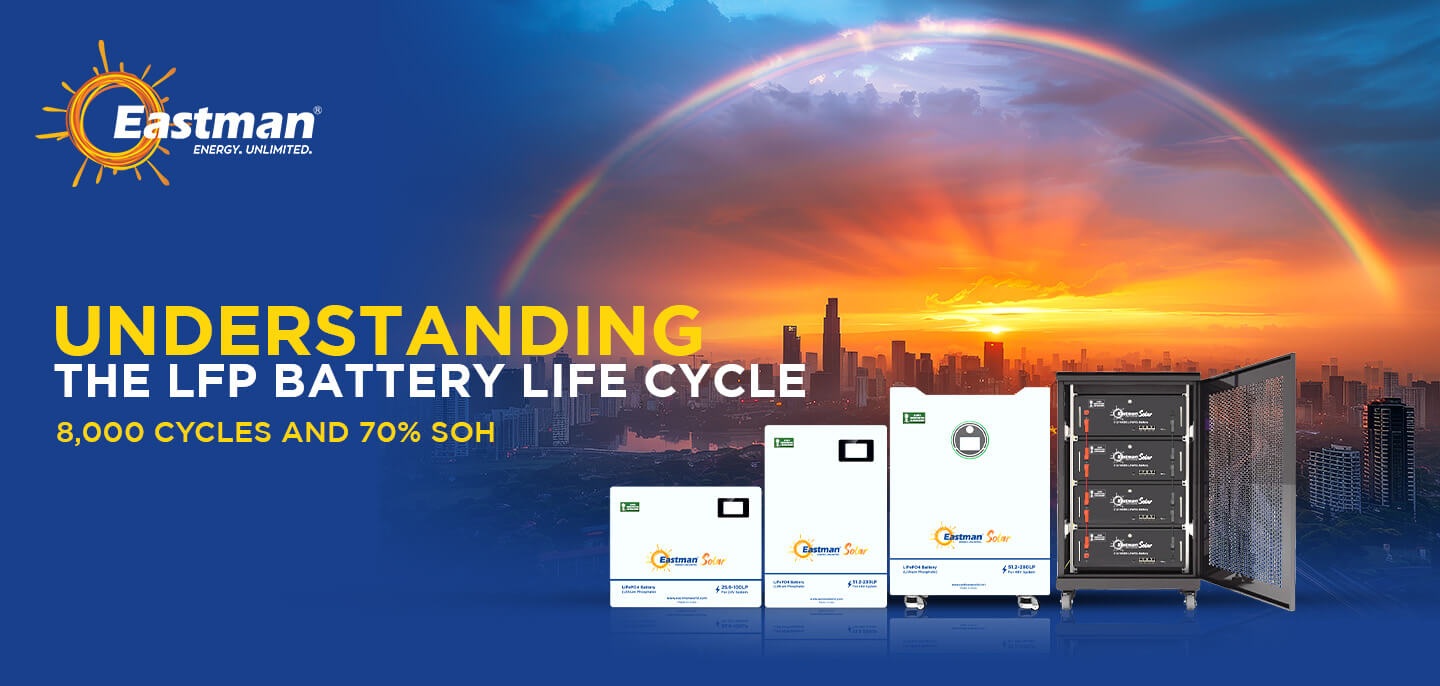
Understanding the LFP Battery Life Cycle: 8,000 Cycles and 70% SOH
SOH vs. DOD in Lithium Iron Phosphate Batteries
Lithium Iron Phosphate (LFP) batteries are widely recognized for their long lifespan, safety, and reliability—especially in energy storage applications such as solar ESS, residential backup, and commercial power systems.
When evaluating LFP batteries, two durability benchmarks are commonly referenced:
- 8,000 cycles to 70% State of Health (SOH)
- 6,000 cycles at 80% Depth of Discharge (DOD)
At first glance, these figures may appear contradictory. However, they often describe the same underlying battery performance, expressed through different testing and usage perspectives.
Decoding the Benchmarks: SOH vs. DOD
8,000 Cycles to 70% SOH Explained
This benchmark defines battery life based on capacity retention. Typically tested at a 0.5P (or 0.5C) charge/discharge rate, one cycle represents a full charge and discharge of the battery’s usable capacity.
After 8,000 cycles, the battery is guaranteed to retain at least 70% of its original rated capacity.
- Metric type: Capacity-based
- Endpoint: 70% SOH
- Test condition: Standardized laboratory test
6,000 Cycles at 80% DOD Explained
This benchmark defines battery life based on a usage pattern rather than a capacity endpoint.
- Metric type: Usage-based
- Endpoint: Typically 70–80% SOH
- Test condition: High daily utilization
The Critical Insight: Same Battery, Different Test Conditions
These two specifications are not contradictory. In most cases, they describe the same LFP battery tested under different conditions.
A battery cycled daily at 80% DOD experiences higher stress, reaching 70% SOH in around 6,000 cycles. The same battery, tested under gentler standardized conditions, may reach 70% SOH after 8,000 cycles.
Why LFP Chemistry Supports Both Claims
1. Structural Stability
LFP batteries use a robust olivine crystal structure, which resists degradation during repeated cycles.
2. Predictable and Gradual Aging
LFP chemistry exhibits slow and linear capacity fade, making performance degradation predictable over time.
3. High Stress Tolerance
Compared to other lithium chemistries, LFP batteries tolerate wider operating conditions with minimal damage.
Practical Application: Choosing the Right Metric
For High Daily Energy Demand Systems
The 6,000 cycles at 80% DOD metric is the most realistic indicator for heavy usage.
For Moderate or Variable Usage Systems
The 8,000-cycle life to 70% SOH provides a broader durability reference.
The Universal Takeaway: Long Service Life
LFP batteries are engineered for long-term performance and exceptional durability, typically delivering 15–20+ years of service.
How to Maximize Your LFP Battery Life
- Right-size the system to keep usage below 80% DOD
- Avoid voltage extremes (20%–90% SOC)
- Maintain moderate operating temperatures
Two Specifications, One Durable Technology
The specifications of 8,000 cycles to 70% SOH and 6,000 cycles at 80% DOD are complementary indicators of the same robust LFP battery life cycle.
