
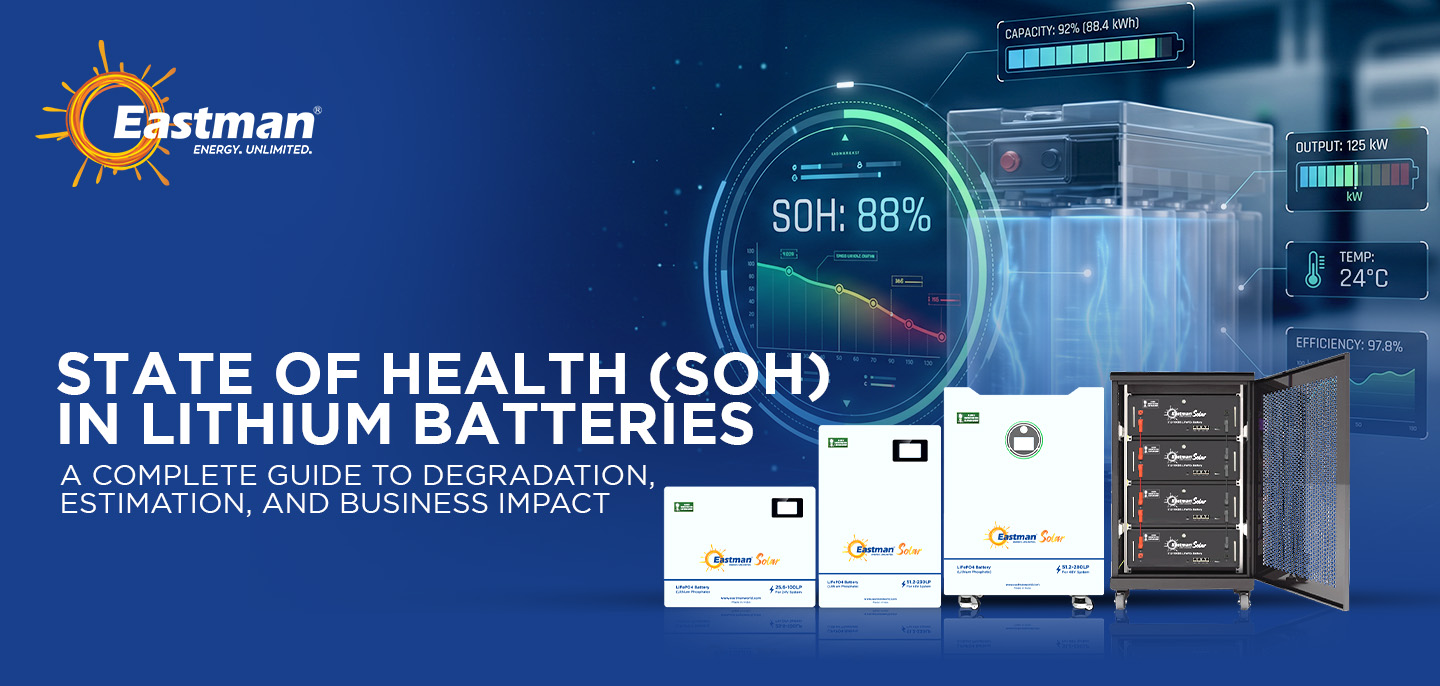
State of Health (SOH) in Lithium Batteries: A Complete Guide to Degradation, Estimation, and Business Impact
As lithium-ion batteries become the backbone of modern Energy Storage Systems (ESS), one metric stands above the rest in determining long-term performance and value: State of Health (SOH).
While many stakeholders focus on State of Charge (SOC)-how full a battery is-SOH answers a far more important question:
For engineers, investors, and system integrators, understanding SOH is essential for ensuring safety, optimizing performance, and protecting return on investment (ROI).
What Is State of Health (SOH)?
State of Health (SOH) measures the current condition of a battery relative to its original, beginning-of-life (BOL) state.
- 100% SOH → Brand-new battery
- 85–90% SOH → Mid-life performance
- 70–80% SOH → End-of-Life (EOL) threshold
Below approximately 70%, degradation often accelerates rapidly, and the battery may no longer meet commercial or safety requirements.
SOH Is More Than Just Capacity
In advanced systems, SOH is not a single number. It includes:
- Capacity SOH (SOH-C) – Energy storage capability
- Power SOH (SOH-P) – Ability to deliver current
- Efficiency SOH – Decline in round-trip efficiency
A battery may retain good capacity but lose power capability—critical in grid applications.
SOH vs SOC: A Critical Distinction
| State of Charge (SOC) | State of Health (SOH) |
|---|---|
| How much energy is available right now | How much life remains in the battery |
| Changes daily | Declines gradually over years |
| Like a fuel gauge | Like engine condition |
Why SOH Matters in Energy Storage Systems
1. Warranty Compliance
Battery warranties are tied to SOH thresholds (e.g., 70% after 10 years).
- Determines eligibility for warranty claims
- Prevents disputes between suppliers and operators
2. Revenue and ROI
SOH directly impacts:
- Usable energy capacity
- System efficiency
- Revenue generation
Even small SOH estimation errors can distort:
- Levelized Cost of Storage (LCOS)
- Long-term financial projections
3. Operational Optimization
As SOH declines:
- Internal resistance increases
- Voltage drops under load
- Heat generation rises
Smart EMS platforms must:
- Derate power output
- Adjust dispatch strategies
- Protect aging assets
4. Safety and Risk Management
Rapid SOH decline can indicate:
- Lithium plating
- Electrolyte degradation
- Internal damage
These can be early indicators of thermal runaway risk.
How Lithium Batteries Degrade
1. Calendar Aging (Time-Based)
Occurs even when the battery is idle.
Key Drivers:
- High temperatures
- High SOC levels
Mechanisms:
- SEI layer growth
- Electrolyte decomposition
2. Cycle Aging (Usage-Based)
Occurs during charging and discharging cycles.
Key Drivers:
- High charge/discharge rates (C-rate)
- Deep Depth of Discharge (DoD)
- Extreme temperatures
Mechanisms:
- Electrode cracking
- Loss of active lithium
3. Impedance Growth
- Ion movement slows
- Internal resistance increases
- Power capability decreases
- Energy loss rises (I²R losses)
The Non-Linear Nature of Degradation
Battery aging typically follows three phases:
- Initial Drop – Rapid decline after deployment
- Stable Phase – Predictable degradation
- Knee Point – Sudden acceleration of aging
The Hidden Drivers of Battery Aging
Temperature (Most Critical Factor)
Battery degradation follows Arrhenius behavior:
A battery operating at 35°C instead of 25°C may lose significantly more capacity over time.
SOC Operating Window
- 20–80% SOC → Longer lifespan
- ≥90% SOC → Faster degradation
This is why most ESS systems avoid full 0–100% cycling.
How SOH Is Estimated
1. Coulomb Counting
- Tracks current over time
- Simple implementation
- Prone to drift over time
2. Internal Resistance Measurement
- Measures voltage response to current
- Reflects power capability
- Highly temperature dependent
3. Model-Based Methods
- Use battery models and real-time data
- Compare predicted vs actual voltage
- Accurate with partial cycles
4. AI & Data-Driven Models
- Analyze historical operational data
- Detect non-linear degradation patterns
- Require large datasets and cloud infrastructure
Key Challenges in SOH Estimation
Environmental Variability
- Temperature affects capacity readings
- Difficult to separate true degradation from temporary effects
The Weakest Cell Problem
- One weak cell limits the entire battery string
- Reduces usable capacity
- Accelerates system-level aging
Application Diversity
- Peak shaving → Few deep cycles
- Frequency regulation → Many micro-cycles
A single SOH model cannot accurately fit every application.
SOH vs Remaining Useful Life (RUL)
SOH indicates current condition, but not future lifespan.
Two batteries at 80% SOH can have vastly different remaining useful lives depending on:
- Usage patterns
- Temperature history
- Degradation trends
System-Level Impact of SOH
As SOH declines:
- Usable energy decreases
- Power output becomes limited
- Maintenance requirements increase
This impacts:
- Capacity planning
- Maintenance strategy
- System reliability
SOH and Total Cost of Ownership (TCO)
SOH directly influences:
- Warranty reserves
- Replacement schedules
- System uptime
- Investment returns
Over a 10–15 year lifecycle, even small improvements in SOH estimation can significantly reduce costs.
The Future of SOH Management
Emerging trends include:
- Digital twin battery models
- AI-driven degradation forecasting
- Cloud-based diagnostics
- Adaptive SOC–SOH control strategies
Future ESS systems will increasingly rely on real-time, data-driven SOH optimization.
Final Thoughts
State of Health (SOH) is more than a battery metric—it is a system-level performance and financial indicator.
For Engineers:
- Better system design
- Safer operation
- Predictive maintenance
For Investors:
- Asset valuation
- Warranty outcomes
- Long-term ROI
