
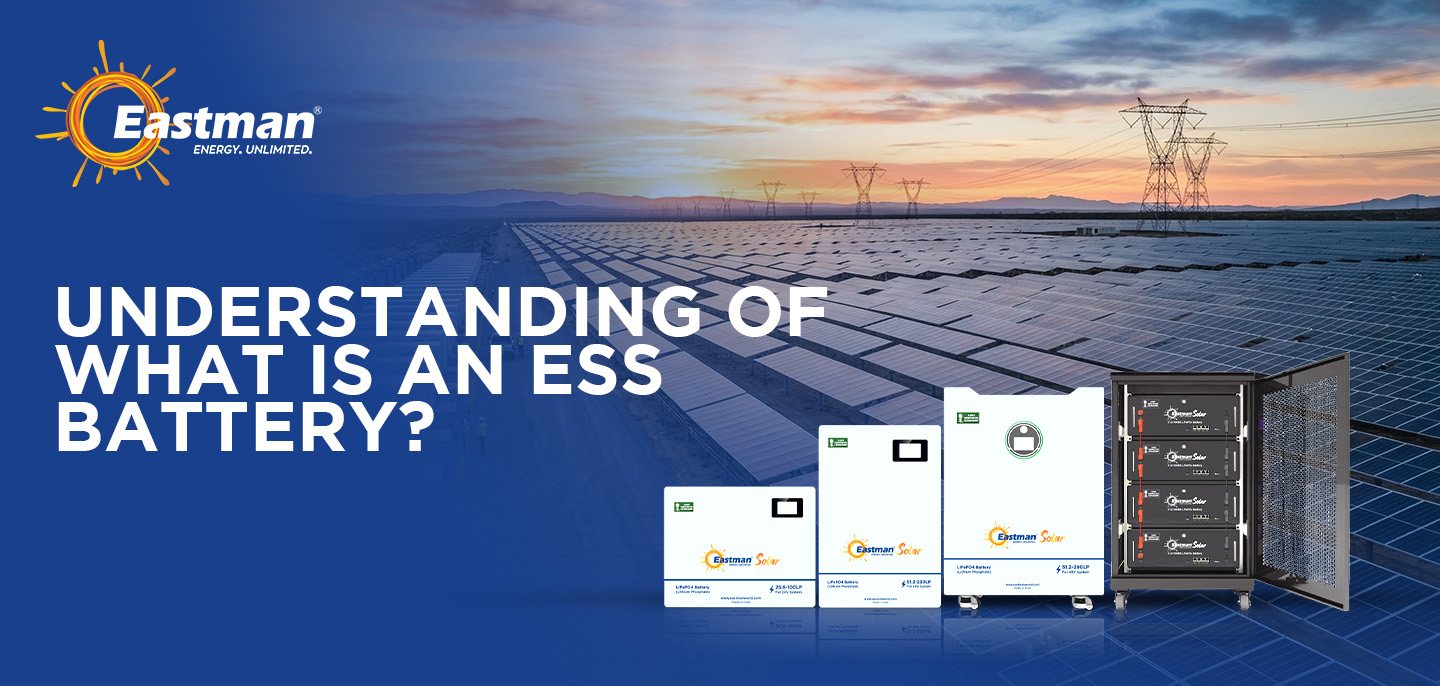
Understanding of what is an ESS Battery?
An Energy Storage System (ESS) battery is a technology designed to store energy and release it when needed. It plays a crucial role in modern energy management by improving the efficiency, reliability, and sustainability of electricity supply.
ESS batteries store excess energy generated from sources such as solar panels, wind turbines, or the electrical grid, and discharge it when demand increases or when power generation is low.
With the growing adoption of renewable energy, power generation has become more variable. ESS batteries help solve this challenge by balancing energy production and consumption, reducing energy waste, improving grid reliability, and ensuring continuous power availability.
Whether used in residential solar systems or large industrial power management, ESS batteries are transforming how energy is stored and utilized.
How ESS Batteries Work
An ESS battery stores energy during periods of low demand and releases it when demand increases. The process typically involves three main stages:
- Energy Capture (Charging Phase)
- The battery receives electrical energy from a power source such as solar panels, wind turbines, or the electrical grid.
- This energy is converted and stored inside the battery in chemical form.
2. Energy Storage (Idle Phase)
- The stored energy remains safely inside the battery until it is needed.
- Advanced Battery Management Systems (BMS) continuously monitor parameters such as battery health, temperature, voltage, and state of charge to ensure safe and efficient operation.
3. Energy Release (Discharging Phase)
- When electricity demand rises, the stored chemical energy is converted back into electrical energy.
- The power is delivered to homes, businesses, or the electrical grid.
- Energy is discharged in a controlled manner to maintain efficiency and protect the battery.
By performing these functions, ESS batteries improve energy resilience, grid stability, and support off-grid power solutions.
Types of ESS Batteries
Different battery technologies are used in energy storage systems. The choice depends on factors such as cost, efficiency, lifespan, and energy capacity.
1. Lithium-Ion Batteries
Lithium-ion batteries are the most widely used technology in modern ESS systems.
They offer:
- High energy density
- Long cycle life
- High efficiency
- Fast charging capability
- Low maintenance requirements
Because of these advantages, lithium-ion batteries are commonly used in residential energy storage systems, electric vehicles, and commercial backup solutions.
2. Lead-Acid Batteries
Lead-acid batteries are one of the oldest rechargeable battery technologies.
They are:
- Cost-effective
- Reliable
- Widely available
However, they have shorter lifespans, lower efficiency, and higher maintenance requirements compared to lithium-ion batteries. They are still used in applications where low initial cost is the primary concern.
3. Flow Batteries
Flow batteries use liquid electrolytes stored in external tanks, allowing energy storage capacity to be scaled easily.
They are particularly suitable for:
- Large-scale renewable energy storage
- Grid-level energy management
However, flow batteries generally require more space and infrastructure compared to lithium-ion systems.
4. Sodium-Ion Batteries
Sodium-ion batteries are emerging as a promising alternative to lithium-ion technology.
They use abundant and low-cost sodium instead of lithium, which helps reduce supply chain risks and production costs. These batteries are especially suitable for stationary energy storage and grid applications, although they are still in the early stages of commercial development.
5. Solid-State Batteries
Solid-state batteries replace the traditional liquid electrolyte with a solid electrolyte.
This technology offers potential advantages such as:
- Higher energy density
- Improved safety
- Longer lifespan
Solid-state batteries are considered a next-generation breakthrough that could significantly enhance both electric vehicles and advanced ESS systems in the future.
Advantages and Applications of ESS Batteries
Advantages of ESS Batteries
ESS batteries provide several benefits across residential, commercial, and industrial sectors.
They help maintain grid stability by balancing electricity supply and demand, preventing power fluctuations and blackouts. They also enable better integration of renewable energy sources like solar and wind, reducing dependence on fossil fuels.
Another major advantage is energy cost savings. Businesses and homeowners can store electricity when prices are low and use it during peak hours when electricity costs are higher.
Additionally, ESS batteries provide reliable backup power, ensuring that critical operations in hospitals, data centres, and industrial facilities continue even during power outages.
Applications of ESS Batteries
Renewable Energy Storage
ESS batteries are widely used for storing energy generated by solar and wind power systems.
Because renewable energy production depends on weather conditions, energy storage is essential for maintaining a stable and reliable power supply.
ESS batteries store excess energy when production is high and release it when production decreases.
Electric Vehicles and Charging Infrastructure
ESS batteries support the development of electric vehicle (EV) charging infrastructure and technologies such as Vehicle-to-Grid (V2G).
V2G systems allow electric vehicles to return stored energy to the grid during peak demand periods, helping stabilize the electricity network.
Grid-Scale Energy Storage
Utility companies use large-scale ESS systems to:
- Stabilize electricity grids
- Manage peak demand loads
- Prevent blackouts and voltage fluctuations
These systems are particularly useful for managing the intermittent energy generation of solar and wind farms.
Industrial and Commercial Applications
Many industries and commercial buildings use ESS batteries to optimize energy consumption and reduce electricity costs.
Factories, shopping malls, office buildings, hospitals, and data centers can store energy during off-peak hours and use it during high-demand periods.
ESS systems also serve as reliable backup power sources for critical operations.
Challenges and the Future of ESS Technology
Despite their advantages, ESS batteries still face several challenges.
Factors such as battery costs, raw material availability, and recycling processes impact the large-scale deployment of energy storage systems.
For example, lithium-ion batteries rely on minerals such as lithium, cobalt, and nickel, which can create supply chain and environmental concerns. Battery recycling and disposal also present environmental challenges.
However, ongoing advancements in solid-state batteries, sodium-ion batteries, and improved recycling technologies are expected to make energy storage systems more sustainable and efficient in the future
Why Choose Eastman for ESS Battery Solutions?
As demand for efficient and sustainable energy storage grows, choosing the right ESS battery provider becomes increasingly important.
As one of the leading lithium-ion battery manufacturers in India, Eastman offers high-performance, durable, and efficient energy storage solutions designed for residential, commercial, and industrial applications.
With advanced technology and reliable performance, Eastman ESS batteries help ensure stable power, improved energy efficiency, and long-term energy independence.
